
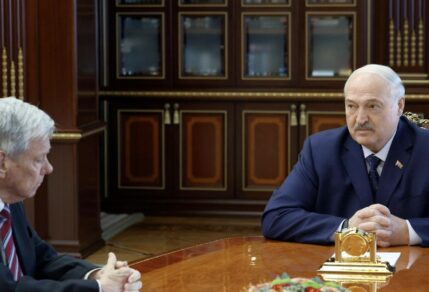
Potential U.S.–Belarus “Big Deal” Could Strengthen Eastern European Security
Potential U.S.–Belarus “Big Deal” Could Strengthen Eastern European Security
Executive Summary:
- March saw a surge in Belarus–U.S. diplomacy. Belarusian President Alyaksandr Lukashenka claimed that he received an invitation to meet with U.S. President Donald Trump regarding a “big deal” and the United States eased sanctions on a group of Belarus-linked potash exporters and financial companies.
- Belarus’s release of over 500 political prisoners over the last year and diplomatic outreach to Washington reflect Minsk’s push to restore economic ties with the West and potentially rebalance its dependence on Russia.
- The reset of U.S.–Belarus relations could lead to Belarus decoupling its military infrastructure from Russia’s strategic goals, thereby strengthening the security of the North Atlantic Treaty Organization’s (NATO) eastern flank and Ukraine’s northern border.
March has seen a flurry of diplomatic activity and comments between Belarus and the United States. On March 20, Belarusian President Alyaksandr Lukashenka claimed that he had received an invitation to meet with U.S. President Donald Trump in Florida regarding a “big deal” between the United States and Belarus (Izvestiya, March 20). This comment followed a March 19 meeting between Lukashenka and U.S. Presidential Envoy John Coale in Minsk. On March 26, the United States eased sanctions on a group of Belarus-linked potash exporters and financial companies. Trump later called Lukashenka a “highly respected president” and expressed his desire to meet with Lukashenka at the next Board of Peace meeting (X/@WhiteHouse, March 29; Delfi, March 30). Belarus and the United States have conducted their relationship without ambassadors since the United States imposed sanctions on Belarus in 2008 in response to Minsk’s human rights abuses, and diplomatic relations have been maintained at the level of chargés d’affaires (DW, August 11, 2021). Sporadic attempts at normalization have been made over the years, but none have led to a full restoration of ambassadorial presence (see EDM, December 4, 2025).
The release of over 500 political prisoners in Belarus over the past year indicates that diplomacy between Minsk and Washington may have entered a transformational phase (see EDM, June 26, July 28, 2025). Appeals from Nobel laureates to the United States in 2024 and 2025 to lobby Minsk accelerated this prisoner release process (Belarus Democratic Forum, December 14, 2025). Belarus made this decision alongside frequent signals expressing its desire for normalization, reflecting a calibrated diplomatic effort to rehabilitate its international image. Minsk’s engagement with Washington could form the groundwork for a future reset in relations between the countries and alter Eastern Europe’s security landscape (BelTA, March 20). Such an arrangement could challenge Moscow’s growing control over Belarus and serve as a new model of engagement between Russia and the West in Eastern Europe. Despite even Lukashenka acknowledging that the United States is not presently prepared to sign a “great treaty,” warming relations between the countries could build to substantive change (BelTA, March 20). Amid Russia’s war against Ukraine and rising tensions between the North Atlantic Treaty Organization (NATO) and Russia, Belarus could serve as a geographic buffer and a potential diplomatic asset for the West.
Lukashenka seeks to establish a direct dialogue with Washington, bypassing multilateral formats. This strategy is designed to overcome Belarus’s “pariah state” status and ease sanctions, particularly in the potash and petrochemical sectors, which are vital to the regime’s financial stability (see EDM, June 30, 2021). Potash fertilizers and refined petroleum products account for a large share of Belarusian exports—restrictions imposed after 2020 led to severe losses in foreign-exchange earnings (Neg.by, April 7). Restoring access to Western markets and technologies could be a cornerstone of any future deal, allowing the regime to stabilize the economy without total reliance on Russia. Lifted sanctions are insufficient—Minsk must rebuild trust with international partners, requiring deeper institutional transformation to restore economic channels that would allow Belarus to partially return to global markets.
Improved relations with the West could reduce Belarus’s economic dependence on Russia and the People’s Republic of China (PRC) (see China Brief, November 11, 2021; see EDM, June 13, 2025). Russia’s increased reliance on trade with Russia and the PRC following increased sanctions in 2020 significantly undermined Minsk’s sovereign decision-making. The expansion of Russian military presence in Belarus—including the potential deployment of tactical nuclear weapons and Moscow’s use of Belarusian territory to launch the full-scale invasion of Ukraine—has also undermined Belarusian sovereignty (see EDM, February 12, June 26, 2025; January 27).
The Belarusian leadership likely hopes to transform the country from a Russian military bridgehead into a buffer space between blocs within the framework of the proposed “big deal.” Such a shift would require complex, multi-level negotiations, including a reduction of Russia’s permanent military presence in exchange for Western security guarantees, economic support, and the gradual restoration of a full U.S. diplomatic mission to counterbalance the Kremlin’s influence. An expanded diplomatic presence could be accompanied by technical assistance programs to strengthen the country’s institutional resilience.
Belarus’s urgent need for economic diversification is partially driving this diplomatic process. Belarus suffers from near-total dependence on the Russian market, energy subsidies, and logistics routes (see EDM, January 19, 2020). By restoring and creating new transit and energy corridors between Baltic ports and Belarus, Lukashenka hopes to reduce dependence on the Kremlin and gain greater maneuvering room. This would involve resuming full use of the ports of Klaipėda, Ventspils, and Riga for Belarusian exports, as well as potentially instituting joint projects to diversify oil and gas supplies via alternative routes (see EDM, May 29, 2020, October 10, 2024). Such initiatives could include Western companies investing in Belarus’s logistics infrastructure, allowing Minsk to bypass Russian tariffs and attract foreign investment into industry. This is particularly relevant as Russian energy subsidies, while keeping the economy afloat, simultaneously increase the regime’s political vulnerability. In practice, however, the entry of American companies into Belarus remains unlikely due to high operational risks and low market margins.
The security levels of Lithuania, Poland, Latvia, and Ukraine’s northern border would increase if Belarus decoupled its military infrastructure from Russia’s strategic goals (see EDM, January 27). Despite being unlikely at present, this scenario could become a vital element of a broader deterrence and de-escalation architecture in the region. This path faces severe systemic obstacles because the Kremlin views any bilateral agreement between Minsk and Washington as an existential threat to its regional hegemony. Moscow possesses a formidable toolkit to sabotage such a deal, including economic leverage, price hikes, market restrictions, or even cutting off energy supplies. Russia could activate further hybrid measures, ranging from media disinformation campaigns to an increased military footprint. Any loosening of control over Belarus would threaten the entire architecture of Russian defense on its western front, including the ability to rapidly deploy troops to NATO borders.
Lukashenka has repeatedly stated that his negotiations with the United States do not mean that he wishes to “be friends against” Russia or the PRC (BelTA, March 20). For Lukashenka, a “big deal” is an attempt to secure his status as a sovereign leader rather than a provincial administrator under Moscow’s thumb. It is also an attempt to redefine Belarus’s role in the international system and ease sanctions pressure. Realizing such a scenario, however, will require political will and readiness for long-term compromise.
If a meeting between Trump and Lukashenka occurs, Belarus would become a higher priority for Western foreign policy. Such a meeting could lead to the release of remaining political prisoners and the closure of legal cases against the Belarusian opposition (see EDM, September 29, 2025). Following the capture of Venezuelan President Nicolás Maduro, conflict with Iran, and the ongoing economic embargo on Cuba, Lukashenka likely perceives heightened risks to his personal security in the event of a confrontation with the United States. In the long term, a U.S.–Belarus agreement could pave the way for a new security model in which Belarus would serve as a stabilizing element between NATO and Russia rather than an outpost of the Kremlin’s confrontation.
Potential U.S.–Belarus “Big Deal” Could Strengthen Eastern European Security - Jamestown

.png)
.png)