IAPB/Dignity: Where Did €10+ Million Go
IAPB/Dignity: Where Did €10+ Million Go?
A Preliminary Analysis of Spending, Structure, and Results (2021–2024)
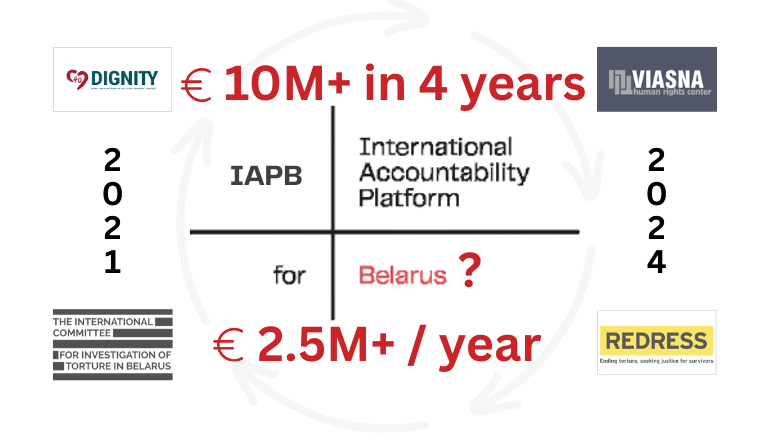
The International Accountability Platform for Belarus (IAPB) - IAP Belarus - is a coalition of independent human rights organizations created in March 2021 to collect, verify, and preserve data on human rights violations in Belarus following the 2020 presidential election. Danish Institute Against Torture (DIGNITY), leads the platform as its Secretariat, responsible for organizing operations and distributing funding.
The project’s mission sounds weighty and relevant - documenting grave human rights violations in Belarus. However, the Platform’s official objectives do not include taking cases to court: it limits itself to collecting and storing evidence. This creates a risk that substantial resources will be spent on staffing, offices, infrastructure, and trainings without any commitment to achieve concrete legal outcomes. For Western taxpayers and donors, as well as for Belarusian society in whose interest the funds were allocated, this means one thing: money may be spent without a direct impact on accountability.
Despite DIGNITY’s claims of transparency and accountability, IAPB’s public documents contain too many generalities and too little specificity. Between 2021 and 2024, more than €10 million (on average €2.56 million per year) was allocated to the project for “collecting and preserving information,” yet it remains unclear who exactly received these funds, what precisely they paid for, and how the results were measured.
Real effectiveness and justification of this spending can only be assessed on the basis of clear and concrete data. That is why we address DIGNITY, as IAPB’s Secretariat, with a set of specific questions (see below). Their answers will show how transparent, efficient, and targeted the expenditures are, and whether they match the stated goals.
- IAPB Structure
- Steering Committee, responsible for strategy and governance.
- Advisory Council, which, in addition to international bodies, IAPB says includes “a number of Belarusian organizations” - although these organizations are not named in the reports.
- Secretariat, located at DIGNITY’s headquarters in Copenhagen, which handles day-to-day management, data storage, and partner coordination.
- DIGNITY – Danish Institute Against Torture — https://dignity.dk/en/
- Human Rights Center “Viasna” — https://spring96.org/en
- International Committee for the Investigation of Torture in Belarus — https://torturesbelarus2020.org/en/
- Redress — https://redress.org/our-work/
includes, besides unspecified “a number of Belarusian organizations”*:
- European Center for Constitutional and Human Rights (ECCHR)
- International Federation for Human Rights (FIDH)
- International Rehabilitation Council for Torture Victims (IRCT)
- Norwegian Helsinki Committee
- Physicians for Human Rights (PHR)
- Reporters Without Borders (RSF)
- World Organisation Against Torture (OMCT)
Secretariat
Operational management of the Platform is handled by the Secretariat based at DIGNITY’s headquarters in Copenhagen. It includes lawyers, doctors, and specialists with experience in criminal investigations and prosecutions.
According to DIGNITY’s website, the IAPB Secretariat:
- collects, verifies, and preserves evidence of international crimes allegedly committed by Belarusian authorities and others before and after the 2020 presidential election;
- interacts with prosecutors in EU countries who investigate crimes committed in Belarus;
- regularly organizes masterclasses and trainings on key topics to support the Platform’s partners in documenting violations.
Over 4 years (2021–2024), 19 donor countries allocated €10.3 million to IAPB’s work (averaging €2.6 million per year). These funds came from Western taxpayers through various governmental and international financing mechanisms. The financial data are confirmed by DIGNITY’s annual reports available publicly: https://dignity.dk/en/about-dignity/
By year:
- 2021 — €1,034,897.07
- 2022 — €3,620,916.23
- 2023 — €3,303,429.62
- 2024 — €2,294,495.00
Total 2021–2024: €10,253,737.92 (DKK 76,374,560.00)
At the same time:
- IAPB’s mission does not include taking cases to court or bringing perpetrators to justice.
- Over 4 years and more than €10 million in spending, there have been no recorded concrete legal outcomes such as initiating or completing court proceedings.
Comparing Spending with Progress Reports
DIGNITY-Annual Financial Report vs. IAPB-Donor-Facing Progress Reports
2021: 7.694.402,00 DKK (1.034.897,07 Euro)
Source: Annual Report 2021 DIGNITY-aarsregnskab-2021.pdf
1st and 2nd Progress Reports (IAPB):
03/21 – 09/21:1st Report
ENG IAPB_FirstReport_Public_FINAL_2021.pdf
+
09/21-01/22: 2nd Report
RU IAPB_Report_Publc_RU.pdf
ENG IAPB_SecondReport_Public_FINAL_2022.pdf
- Already in the first year, a full Secretariat was formed in Denmark, including a head, lawyers, analysts, investigators, and a physician.
- Significant resources were directed to equipment purchases and building infrastructure in Copenhagen.
2022: 26.941.341,00 DKK (3.620.916,23 Euro)
Source: Annual Report 2022 DIGNITY-Åarsregnskab 2022.pdf3
3rd and 4th Progress Reports (IAPB):
02/22 – 09/22: 3rd Report
RU IAPB_ThirdReport_Public_RUSSIAN.pdf
ENG IAPB_ThirdReport_Public_ENGLISH.pdf
+
10/22 – 03/23: 4th Report
RU IAPB_2023_Fourth_Progress_Report_Public_RU.pdf
ENG IAPB_2023_Fourth_Progress_Report_Public_ENG.pdf
- It is stated that the Advisory Council includes “a number of Belarusian organizations,” but no names are provided - creating the impression of a donor-facing PR move.
- In February 2022, a data systems manager and another Russian-speaking open-source investigator were hired - even though OSINT data are accessible to any researcher online. This may indicate staff inflation and questionable spending efficiency.
- Funding continued for in-person and online trainings, including mock trials, while IAPB’s founding documents do not commit to taking cases to actual courts.
2023: 24.615.720,00 DKK (3.303.429,62 Euro)
Source: Annual Report 2023 DIGNITY - Annual_report_2023.pdf
5th and 6th Progress Reports (IAPB):
04/23 – 09/23: 5th Report
RU IAPb_Oct2023_Report_Public_RU_1120.pdf
ENG IAPb_Oct2023_Report_Public_ENG_1121.pdf
+
10/23 – 03/24: 6th Report
RU IAPB-Sixth-Progress-Report_RU.pdf
ENG IAPB-Sixth-Progress-Report.pdf
Substantial funds were directed to mock trials and thematic trainings on international standards - without confirmation of their practical application in real investigations.
2024: 17.123.097,00 DKK (2.294.495,00 Euro)
Source: Annual Report 2024 DIGNITY - Annual-Report-2024 -24.04.2025-.pdf
7th and 8th Progress Reports (IAPB):
04/24 – 09/24: 7th Report
RU 7th-Progress-Report-April-Sept-2024_RU.pdf
ENG 7th-Progress-Report-April-Sept-2024.pdf
+
10/24 – 03/25: 8th Report
RU 8th-PROGRESS-REPORT-PUBLIC_ru.pdf
ENG 8th-PROGRESS-REPORT-PUBLIC_en.pdf
Overall results for 2021–2024:
Over the entire period, the project declares 29,492 documents and 2,637 interviews, but public reports do not explain how exactly these materials were used in specific investigations or court proceedings.
If we distribute the total budget (€10,253,737.92) across these outputs, then:
- one document cost ~€348;
- one interview cost ~€3,888.
€3,888 per interview is comparable to a monthly salary in Europe or several years of income in Belarus, given that an interview can last a couple of hours.
These calculations include everything - from staff salaries in Copenhagen and office rent to “well-being” seminars and mock trials.
A natural question arises: Are such expenditures justified and proportionate to real results in bringing perpetrators to justice?
An analysis of DIGNITY’s annual reports and IAPB progress reports for 2021-2024 highlights key spending areas that require separate scrutiny.
Below are the main expense lines - from staff and infrastructure to events, partner payments, and victim support.
- STAFF / DIGNITY Headcount for IAPB
What reports show in practice
Progress reports for 2021–2022 indicate the actual staff was significantly larger.
- 2021 (September): at project launch - a full team: head, project manager, senior prosecutor, lawyer, analyst, two investigators, and a physician.
For the initial phase, this looks excessively large, especially with two investigators and a physician on permanent staff. - 2022 (January): two additional lawyers via co-founder REDRESS, despite already having a lawyer.
This suggests duplication of functions. - 2022 (February): a data systems manager and another Russian-speaking OSINT investigator were hired, implying at least one such staffer was already in place.
OSINT largely relies on open, free sources, and there is no evidence of these data being used in courts - this looks like unjustified staff expansion. - 2023: no new positions are mentioned in the public portions of reports, but there is active reference to specialists in IT security, international standards, and mock trials for trainings.
- 2024: offsite seminars and self-care activities for the team are recorded “to enhance resilience.”
A substantial share of resources is directed to internal staff comfort.
Based on average Danish gross salaries, maintaining such a team (about 11 people) annually could cost:
- Minimum: ~€955k (≈37% of IAPB’s budget)
- Maximum: ~€1.145m (≈45% of IAPB’s budget)
Conclusion:
IAPB’s actual staff within DIGNITY significantly exceeds what is listed on the official website. Some positions duplicate functions, and the effectiveness of their work in securing accountability is not evidenced publicly. This creates the impression that a substantial share of funds went to maintaining the apparatus rather than to concrete legal actions.
II. Infrastructure and Operational Expenses of IAPB
What the reports state:
- Office rent and maintenance in Copenhagen (DIGNITY HQ).
- Purchase of servers, data storage/processing equipment, and specialized software.
- Payment for IT systems and data protection measures (GDPR, cybersecurity).
- No breakdown of amounts and budget shares by line item—impossible to assess how much went specifically to infrastructure.
- It is not indicated whether DIGNITY’s existing capacities (office, servers, IT infrastructure) were used, or if everything was purchased anew for IAPB, potentially inflating costs.
- No information on license costs, maintenance, and system upgrades.
- It is unclear whether independent audits of IT security and data protection were conducted, even though handling sensitive materials requires regular checks.
III. Events and Trainings
What the reports state:
- Regular online and offline trainings for partners, including:
- IT security and GDPR compliance;
- documentation of violations, including Istanbul Protocol standards;
- international norms and procedures;
- Mock trials.
- trainings on documenting deportation, sexual violence, and elements of crimes against humanity;
- offsite seminars and events for “team resilience” and “well-being.”
- No breakdown of amounts spent on each training or event.
- No data on participant numbers, their organizations, selection criteria, or concrete learning outcomes.
- Topic repetition (e.g., annual IT-security or documentation trainings) suggests the same modules are replicated for reporting purposes.
- Offsite “well-being” events look unrelated to IAPB’s mandate of accountability.
- No indication whether the acquired knowledge was applied in practice and whether documentation or investigations improved.
IV. Partner Payments and Services
What the reports state:
- Funding for IAPB co-founders’ work:
- Human Rights Center “Viasna” - a key partner, cited as a major provider of data on violations.
- International Committee for the Investigation of Torture in Belarus - a coalition of experts and human rights defenders collecting testimonies.
- REDRESS - an international organization specializing in legal advocacy for torture survivors.
- Coverage of costs for lawyers and analysts engaged through these organizations.
- In several progress reports, it is separately noted that the Advisory Council includes “in addition to a number of Belarusian organizations” - without naming them
- No specifics about what services were provided under these payments and the actual volume of each partner’s work.
- No data on outcomes: how many cases were forwarded to competent authorities, how many prosecutions were initiated, how many decisions by international bodies relied on these materials.
- It is unclear whether partner services duplicated functions already present within DIGNITY’s IAPB team.
- The wording “a number of Belarusian organizations” is especially questionable, given that work inside Belarus was not conducted and could not be conducted under current repression. This creates a risk that these are either formal partners operating from abroad or nominal structures used to create an impression of broad involvement for donors.
V. Support to Victims
What the reports state:
• Psychological and psychosocial support to witnesses and victims of state violence.
• Referrals to specialized services providing:
- medical care,
- social assistance,
- psychosocial support,
- legal aid.
• “Providing information” about available resources and organizations is also listed as “assistance“.
Why this raises questions:
• “Providing information” looks like a minimal action that requires few resources but allows it to be included in reports as assistance rendered.
• Reports do not indicate how effectiveness is measured (number of recipients, support duration, outcomes).
• It is not disclosed whether assistance was provided directly by IAPB/DIGNITY or fully outsourced to third parties.
• It is unclear what portion of the budget went to this area and whether specialized, licensed, and qualified services were engaged.
• Without transparent figures, “support to victims” risks being used as a broad, vague label to justify spending that is not directly related to rehabilitation.
Final Conclusions
An analysis of DIGNITY’s annual financial reports (2021–2024) and eight IAPB progress reports shows that over four years the project received €10,253,737.92, averaging more than €2.5 million per year from donor states. Yet the spending structure remains opaque, and final outcomes are not measured by court proceedings or holding specific individuals accountable.
Key Observations:
- Staff. IAPB’s actual headcount within DIGNITY far exceeds what is shown on the official website and includes at least 11 staff. The high cost of maintaining such a team, absent concrete legal results, calls spending efficiency into question.
- Infrastructure. Significant costs for office, equipment, IT systems, and cybersecurity, with no itemized disclosure. The question of access to confidential information remains open, especially where staff may have political affiliations.
- Events and trainings. Numerous sessions (including offsite “retreats” for team well-being) are conducted without disclosure of costs, participant criteria, or outcome assessments.
- Partner payments. Funding of co-founders and unspecified “Belarusian organizations” that, under conditions of repression, could not operate inside the country. Reports do not indicate practical results of their work.
- Support to victims. Psychological, medical, social, and legal aid is claimed, yet there are no data on scale, providers, budget volumes, or effectiveness.
IAPB’s founding documents do not explicitly enshrine the ultimate goal of bringing perpetrators to justice. The official mission is limited to collecting, verifying, and preserving evidence, as well as “engagement” with international bodies. This means the project can spend millions of euros without any obligation to move materials toward prosecution.
Conclusion
In the absence of detailed spending disclosure and concrete performance indicators, there is a high risk that a significant portion of the budget is spent on maintaining the apparatus, infrastructure, and activities whose value for real justice remains doubtful. As a result, Western taxpayers and Belarusian society - in whose interest these funds were allocated - cannot be confident that this money is truly bringing the moment of accountability closer.
Questions to DIGNITY as IAPB Secretariat
Despite claims of transparency and accountability, IAPB’s public documents are overly general and lack specificity.
More than €10.3 million (on average €2.6 million per year) has flowed through the project over four years, yet it remains unclear: who exactly received funding, what precisely the funds paid for, and how results were measured.
Therefore, we address DIGNITY, as IAPB’s Secretariat, with a list of direct and specific questions whose answers will help determine how efficiently and purposefully Western taxpayers’ funds were used and whether these expenditures match the stated goals.
I. Staff
- What was the total budget allocated to IAPB staff salaries in 2021–2024?
- Why does DIGNITY’s website list only four Belarus-related staff, while the reports indicate a much larger team (at least 11 people)?
II. Infrastructure and Operating Costs
- What amounts were spent on office rent, equipment purchases, servers, cloud storage, and data protection systems under IAPB in 2021–2024? Please provide a breakdown by year and expense category.
- Where exactly (physically and/or in the cloud) are the collected data stored? What cybersecurity measures are applied to protect them, including threats from third parties (e.g., Belarusian KGB)? Who has access to these data, and how is access logged?
IV. Partner Payments and Services
- Which “Belarusian organizations” received funding under IAPB? (Without this information, transparency of fund distribution cannot be verified.)
- By what criteria and on whose recommendation were these organizations selected for funding?
- Why are these organizations not named in public reports? (The absence of such data prevents assessment of partner performance.)
V. Support to Victims
- What share of the budget was devoted to psychological, medical, and legal aid to victims, and who exactly provided these services?
- Do reports exist with quantitative and qualitative indicators of assistance provided (number of recipients, duration, outcomes)?
- How are organizations or specialists providing these services selected?
- How does IAPB verify the quality and effectiveness of the assistance? Is there follow-up with recipients, and who is responsible for quality control?
Closing
Until these questions are answered, doubts remain about both the effectiveness and the target use of funds. With a budget exceeding €10 million over four years, Western taxpayers and donors, as well as Belarusian society - in whose interest the funds were allocated - are entitled to demand full transparency and an independent audit.
Without this, IAPB risks going down in history not as an instrument of justice but as an example of an expensive yet low-impact project.
13 August 2025
*English translation created with the assistance of AI